Breath Awareness – Practice Notes
Breath Awareness is one of the four key Recharge techniques included in many of our workshops. Please refer to the General Practice Guidelines in addition to those below prior to listening to the technique mp3 on the WMA Training app.
The body
- Ensure that the body is warm and comfortable. The body temperature will drop during the practice.
- Breath Awareness can be practiced from a lying or seated position. When you feel comfortable, practice with the eyes closed.
The breath
- Aim to breathe in and out through the nose.
Avoid strain
- Aim to breathe in a smooth and comfortable way. Avoid shortness of breath and practice comfortably within your lung capacity so as not to damage the lung tissues.
- In Abdominal Breathing the aim is to breathe in an exaggerated way, but without strain. On the inhalation, avoid over-filling the lungs with air – make the lungs comfortably full. On the exhalation breathe out fully, but again without strain – make the lungs comfortably empty.
- At no time should the breath be forced or strained.
Use your hands
- Placing the palm of one hand on the chest and the other on the belly is a great way to increase awareness of your breathing patterns.
How to practice Breath Awareness
Breath Awareness combines four distinct breathing techniques:
- Natural Breath Awareness: this technique involves being aware of the natural breath as it is, without variation or manipulation. It trains us to get into the habit of observing our breath in everyday life. Simply by doing this we switch off our SNS and calm and regulate the mind.
- Abdominal Breathing: this technique is not practiced during the contact session. However, it forms part of the lying-down version of Breath Awareness.
This technique trains us to breathe more deeply and can be performed lying down or sitting up. Chest breathing is associated with the SNS. Diaphragmatic (belly) breathing is associated with the PNS. Abdominal Breathing is a conscious, deliberate, exaggerated breath into the belly only and works to activate the PNS. In this practice the chest remains as still as possible and the diaphragm muscle is used to breathe.
Abdominal Breathing is practiced as follows:
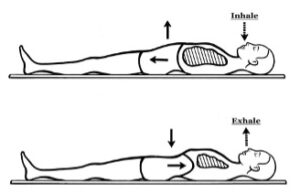
- Maintain awareness of the abdomen and, for a few moments, continue to observe its natural rise and fall.
- Place one hand on the belly and the other on the chest.
- On the inhalation slowly and gently expand the abdomen until it’s comfortably full.
- On the exhalation gently draw the abdomen inwards (towards the spine).
- Continue breathing in this way for a few minutes.
- Notice that the hand on the belly moves up with the inhalation and down with the exhalation. The chest, shoulders and opposite hand remain as still as possible. The breath is into the abdomen only.
- Counting the Breath: this technique helps to keep the mind focused during the practice. As you will discover through practice, being focused has a whole range of mind-management benefits.
- Alternate Nostril Breathing (mental variation): this technique activates the left and right hemispheres of the brain and exercises the corpus callosum (the channel between the two hemispheres) improving brain connectivity. The technique works to create a sense of relaxed alertness, balancing the SNS and PNS. The technique involves moving your attention in a particular way, and is practiced as follows:
- Sit comfortably with the eyes closed, and the spine upright and straight.
- Become aware of the breath, and the entrance to the left nostril.
- As the body inhales move your attention (awareness) along a path up the left nostril to a point at the eyebrow centre.
- As the body exhales move your attention down the right nostril.
- On inhalation move your attention back up the right nostril to the eyebrow centre.
- On exhalation move your attention down the left nostril. This completes one round.
- Continue to move your attention in this way for up to 10 rounds. It’s as if your attention is tracing an inverted ‘V’ shape up and down the nostrils.
- On completion spend a couple of minutes observing the effects.
Note: The physical variation of Alternate Nostril Breathing (practiced in the full-day program) has been shown to rapidly reduce heart rate and blood pressure, and significantly improve problem-solving ability (Subbalakshmi, 2005).