Mindful Movement – Practice Notes
Mindful Movement is one of the four key Recharge techniques included in many of our workshops. Please refer to the General Practice Guidelines in addition to those below prior to listening to the technique mp3 on the WMA Training app.
Mindful Movement is a series of extremely gentle physical exercises performed slowly and with full awareness of the body and the breath. As the name suggests, Mindful Movement is about being mindful of the movements of the body. It is not about turning yourself into a human pretzel, although your flexibility will improve! Nor is it about giving your body an intense physical workout, although you will feel refreshed afterwards!
Mindful Movement trains us to be less reactive to our thoughts, feelings and cognitive associations, and, therefore, to be more present. We practice observing the movement and sensations of the body; every time we realize we have become absorbed in our thoughts, we bring our attention back to the body and continue. This trains our mind to remain aware of what we are actually doing as we move through our everyday lives, thus providing a specific opportunity to change the habit pattern of becoming involved in the drama of our thoughts (ruminating about the past and worrying about the future). The more we practice not reacting to our thoughts the more it becomes our habit.
The practice also works to release accumulated tension from the muscles and joints, and helps to counter the negative effects of prolonged stress. The physiological benefits include:
- release of muscular tension – relieving chronic soreness and pain
- exercising of all the major joints of the body, and maintenance of joint mobility
- increased flexibility
- improved circulation
- release and elimination of toxins
- increased energy levels and stamina, and
- stimulation and balance of all the systems of the body – including the nervous, endocrine (hormonal) and immune systems.
Regular practice of Mindful Movement is an excellent way to release bodily tensions and soreness, particularly for those of us that spend time driving, flying or sitting at a desk.
Practice Guidelines
The body
- Practice with the eyes closed as soon as you feel comfortable with the techniques. This will help to minimise distractions.
- Mindful Movement can be practiced from a sitting, lying or standing position – whichever is most convenient for you. If sitting, ensure that the spine is upright and straight. Use as many supports as you need to create maximum comfort.
The breath
- Aim to co-ordinate the movements with the breath. Practice flowing with the breath. As you learn to create rhythm and grace in the body you will begin to create rhythm and grace in your life.
Mindfulness
- Practice keeping your awareness (your attention) focused on the body and the breath. Each time the mind wanders, simply re-focus your attention and continue with the practice.
- Allow the body to rest between postures and feel into the relevant body part or joint. Observe any sensations or other experiences. If there are no sensations then that is the experience to be observed. Observe also the reactions of the mind. Simply notice what the mind does – how it behaves – then continue with the practice. This rest period is as important as the movement itself. It allows the body to settle and provides an opportunity to practice mindfulness – to observe, but not react to, any sensations, thoughts or emotions that arise.
- There is no such thing as a ‘right’ or ‘wrong’ experience, sensation or thought. Things simply are as they are!
Avoid Strain
- Remember to honour your body. Practice without strain and take rest as you need. Skip any practice that is not suitable for you. If pain is experienced then modify or discontinue the practice and move on. Work comfortably within your range of movement. The primary aim is to move with mindfulness, rather than to increase flexibility.
Visualizing the practices
If you find that a practice is unsuitable, you might like to try visualising, or imagining, yourself making the physical movements. Our instinctual brain cannot tell the difference between real and imaginary experiences, so when you visualise yourself moving in a calm and relaxed way the brain receives the benefits.
Toe Bending |
· Inhale – draw the toes gently back towards the body and separate them widely apart (move only the toes).
· Exhale – slowly curl up the toes. This is one round. · Complete 3 to 5 rounds. · On completion of the rounds, release the practice. Remain aware of the toes and observe any sensations that arise.
|
|
|
||
Ankle Rotations |
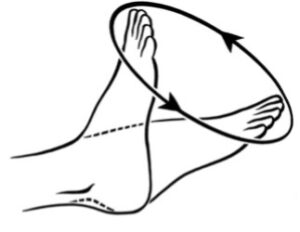
· Check that the feet are relaxed and together. Draw the feet back towards the body. This is the starting position. · Exhale – rotate the feet out to the right side, in a clockwise direction, and down towards the floor. · Inhale – rotate the feet out to the left side and back up towards the body. This is one round. · Complete 3 to 5 rounds in this direction and then practice in the opposite direction. · Observe any sensations that arise.
|
|
|
||
Knee Bending |
Sitting variation
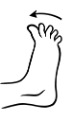
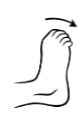
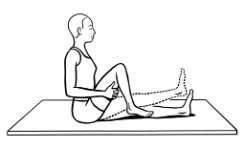
· Bend the right knee and bring the knee towards the chest. · Interlock the fingers behind the knee. · Keep the right foot slightly raised off the floor throughout the practice. · Inhale – straighten the leg and press out through the heel, bringing the foot back towards the body. · Exhale – bring the knee back towards the chest. This is one round. · Complete 3 – 5 rounds and then release the leg along the floor. · Then practice with the left leg. · Observe any sensations that arise. |
|
|
||
| Lying down variation
· Lying on the back, raise the thigh to a vertical position and interlock the fingers behind the mid-thigh. · Inhale – extend the knee, raising the lower leg to vertical. Exhale – bend the knee, bringing the lower leg slowly down to the starting position.
|
||
Hip Opening |
Sitting variation
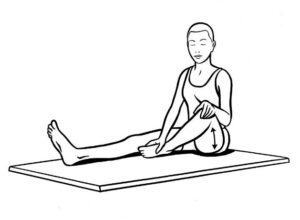
· Bend the right knee and bring the knee towards the chest. Place the foot on the floor. · Take the knee out to the right side and lower the knee towards the floor. Cradle the knee in the right hand and place the left hand on the right ankle. · Inhale – gently draw the knee up towards the chest. · Exhale – lower the knee back towards the floor and place a gentle downwards pressure on the knee. This is one round. · Complete 3 – 5 rounds. · To release out of the posture bring the knee back towards the chest and then release the leg along the floor. · Then practice with the left leg. · Observe any sensations that arise. |
|
 |
||
| Lying down variation
· Lying on the back, practice with the palms down on the floor or with the hands anchoring the hip bones. · Inhale – raise the knee towards the vertical position. Exhale – lower the knee out to the side and towards the floor. |
||
Hand Clenching |
· Keeping the elbows on the floor raise the forearms to vertical.
· Curl the fingers around the thumbs forming loose fists. · Inhale – slowly uncurl and straighten the fingers and thumb, and separate them widely apart. · Exhale – bring the thumbs back into the palms and curl the fingers around the thumb into loose fists. This is one round. · Complete 3 – 5 rounds and then lower the hands to the floor. · Observe any sensations that arise.
|
|
|
||
Wrist Rotations |
· Keeping the elbows on the floor, raise the forearms to vertical.
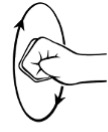
· Curl the fingers around the thumbs forming loose fists. · Flex the wrists and bring the hands back towards the body. This is the starting position. · Exhale – slowly rotate both wrists in a clockwise direction taking the hands down towards the floor. · Inhale – continue the rotation bringing the hands back up to the starting position. This is one round. · Complete 3 to 5 rounds in this direction and then practice in the opposite direction. · Observe any sensations that arise.
|
|
|
||


Elbow Bending |
· Start with the arms on the floor alongside the body or out to the sides with the palms facing up.
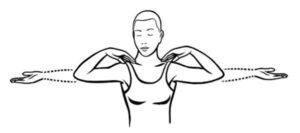
· Exhale – bend the elbows and bring the fingertips to the shoulders. · Inhale – straighten the arms along the floor. This is one round. · Complete 3 – 5 rounds and then lower the hands to the floor. · Observe any sensations that arise. |
|
 |
||
Shoulder Rotations |
· Start with the arms on the floor alongside the body or out to the sides with the palms facing up.
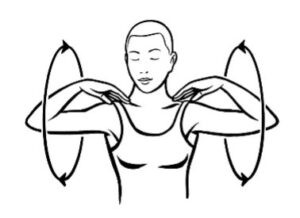
· Bend the elbows bringing the fingertips to the shoulders then bring the elbows towards each other in front of the chest. · Inhale – raise the elbows above the head and out to the sides of the body. The arms may be in contact with the floor at this point. · Exhale – swing the arms down towards the feet then in front of the chest. This is one round. · Complete 3 to 5 rounds in this direction and then practice in the opposite direction. · Observe any sensations that arise. |
|
 |
||
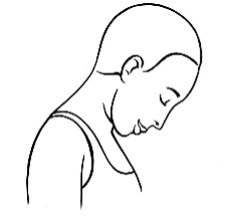
Neck Movements – stage 1 |
· Inhale – slowly and smoothly raise the chin towards the ceiling. Aim to tilt the head, rather than bend the neck.
· Exhale – gently draw the chin down towards the chest. This is one round. · Complete 3 to 5 rounds. · Observe any sensations that arise. |
|
 |
||
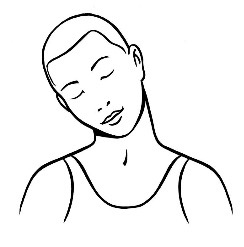
Neck Movements – stage 2 |
· Exhale – slowly and smoothly tilt the head to the right taking the right ear towards the right shoulder.
· Inhale – bring the head back to centre. · Exhale – tilt the head to the left side. · Inhale – bring the head back to centre. This is one round. · Complete 3 to 5 rounds. · Observe any sensations that arise.
|
|
|
||
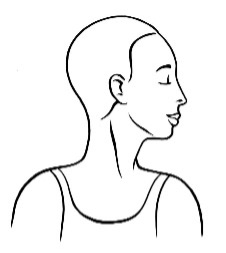
Neck Movements – stage 3 |
· Exhale – slowly and smoothly turn the head to the right as if you’re looking over the right shoulder.
· Inhale – bring the head back to centre. · Exhale – turn the head to the left side. · Inhale – bring the head back to centre. This is one round. · Complete 3 to 5 rounds. · Observe any sensations that arise. |
|
 |